Reliability Is Not Uptime: What It Really Means to Build a Resilient Product
A platform can hit 99.9% uptime and still fail its users when it matters most. Reliability is decided by how a product behaves, communicates and recovers when things go wrong – and for regulated EU platforms, DORA now makes that an obligation.
Uptime is a measurement; reliability is a promise. A platform can meet its SLA and still fail its users at the moments that matter most. What really determines reliability is how a product degrades, how it communicates during failure, and how it earns trust back during recovery. For platforms in regulated EU markets, DORA turns that from good practice into a verifiable obligation.
Somewhere along the way, the industry agreed to measure reliability with a single number: uptime percentage. Platforms advertise 99.9%, enterprise contracts demand 99.99%, and SLAs are signed. Thus, reliability is considered solved.
But it is not solved. Uptime is a measurement and reliability is a promise but they are not the same thing.
A platform can maintain 99.9% uptime and still fail its users in the moments that matter most. It can hit its SLA for eleven and a half months and then be unavailable during the two weeks that contain Black Friday, payroll processing, year-end reporting, or a user’s mortgage application. The percentage says nothing about when the downtime happens, how users experience it when it does, or whether they come back afterwards.
This post is about what reliability actually requires: the product and engineering decisions that determine how a platform behaves when things go wrong, how it communicates during failure, and how it earns trust back during recovery. For platforms operating in regulated EU markets, it also covers what DORA (Digital Operational Resilience Act) now requires from financial entities and the technology providers serving them.
Pay Attention to the Numbers

A 99.9% uptime SLA permits 8.76 hours of downtime per year. 99.99% permits 52.6 minutes. These numbers are annual averages, but they say nothing about distribution.
An 8-hour outage spread across quiet Sunday mornings is a different experience than 8 hours of downtime concentrated during peak usage. A 20-minute outage on a payroll platform that hits on the first of the month affects every employer running payroll that day. A 45-minute authentication failure during the final hours of a tax submission deadline is not equivalent to the same failure on a weekend or at night.
Uptime SLAs also do not capture partial availability. A platform may be technically “up” while its payment processing is degraded, its search is returning stale results, or its email verification is silently failing. These partial failures rarely appear in uptime metrics, but users experience them as failures of exactly the same kind.
The first shift in thinking about reliability: stop treating uptime as the primary metric and start asking what the experience of failure looks like, and when it happens.
3 Ways Systems Fail
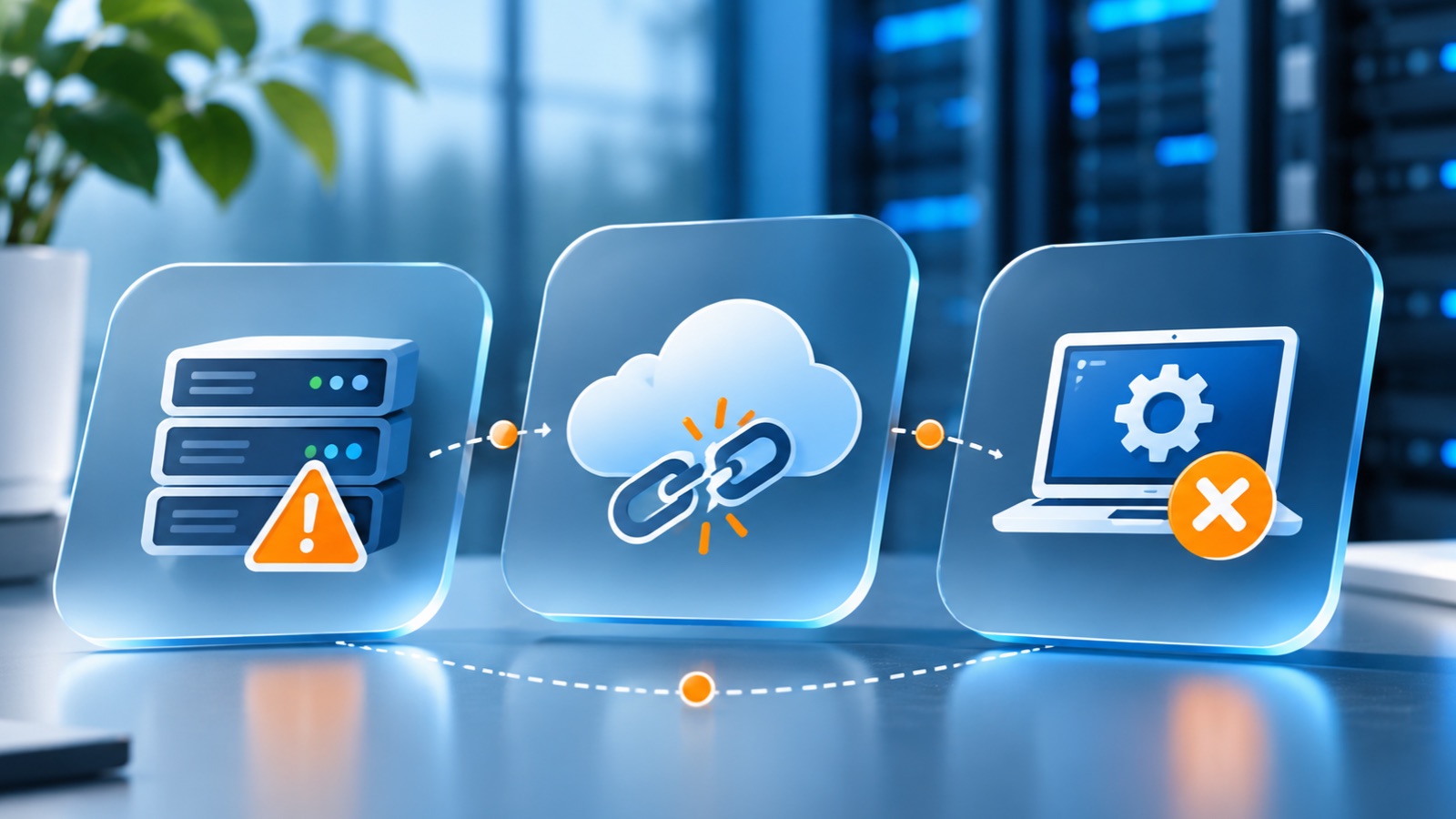
Platforms fail in one of three modes, and each requires a different response.
Hard failure is the most visible: the platform is clearly down, users see an error state, and nothing works. Ironically, hard failures are often the easiest to manage, because they are unambiguous. Both users and your team know something is wrong and needs to be addressed immediately.
Silent failure is the most damaging: the platform appears functional but is producing wrong outputs. Orders are accepted but not processed. Data appears current but is hours out of date. Identity checks are running but returning stale results. Users proceed through their workflow with no indication anything is wrong, and discover the problem later, often at a moment of higher stakes. Silent failures are expensive because they contaminate data, create downstream errors, and are discovered late.
Partial failure sits between the two: some parts of the platform work, others do not, with no clear signal to users about which. This is the most common mode in distributed systems, and the hardest to handle well. It is also where graceful degradation becomes a design discipline rather than an engineering concept.
Graceful Degradation as a Product Decision

Graceful degradation is typically framed as an engineering problem: what happens when a downstream dependency fails? But the user-facing expression of that decision is a product problem.
When a secondary service fails, the product team has made an implicit choice about which of these things happens:
- The whole platform fails because one dependency is unavailable
- The platform continues with reduced functionality, with a clear explanation of what is not available and why
- The platform continues silently, with degraded data quality that users cannot detect
- The platform shows a vague error that tells users nothing useful
The third option is the silent failure mode. The first is often the result of insufficient isolation between services. The fourth erodes trust without giving users anything to act on.
The second option is graceful degradation done well: the platform distinguishes between its core capability (which must remain available) and its secondary features (which can degrade without breaking the core value). A payment platform where the recommendations engine fails should not prevent transactions. An identity verification platform where document scanning is degraded should offer an alternative pathway rather than a generic error.
Graceful degradation requires explicit product decisions:
- What is the minimum viable state of this product? Define which features are core (must work) and which are supplementary (can degrade). This is not an engineering question, but a product question that engineering then implements.
- How does the product communicate its current state to users? A status display showing “Your account data is current as of 14:23 UTC” is not a failure message. It is honest information that lets users make decisions. Many platforms do not surface this because building it requires treating state visibility as a feature, not an afterthought.
- What happens to actions queued during partial availability? A user who submits a form during a degraded state needs to know whether their action was received, queued, or lost. “We’ve saved your request and will process it once service is restored” is a different user experience than a spinner that times out without explanation.
Incident Communication Is a Trust Design Problem
How a platform communicates during an incident determines as much of the trust outcome as the incident itself. This is well-documented in service operations research and in the experience of teams that have handled both well and badly.
The pattern that erodes trust follows a predictable shape: users discover the problem before the platform acknowledges it; the first communication is vague; updates are infrequent; and the post-incident communication explains what happened without committing to what changes.
The pattern that preserves trust looks different. The first acknowledgment is fast, even when the investigation is incomplete. “We are aware of an issue affecting payment processing in the EU West. We are investigating and will update at 15:00 UTC” gives users 3 things: confirmation that the problem is known, a scope, and a next update time. All three are achievable without knowing the root cause.
Subsequent updates maintain specificity. Not “we continue to investigate” but “the issue has been isolated to our identity verification provider. We are working with them on resolution. Estimated resolution: 16:30 UTC.” Each update moves the information forward.
The post-incident communication (published at a committed time, not when the team feels ready) covers 4 things: what happened, when, which users were affected, and what changed to prevent recurrence. The last item is the one most post-mortems omit. Without it, the communication is a description of the past with no signal about the future.
For platforms targeting regulated markets, there is a compliance dimension to this. DORA requires financial entities to report major ICT incidents to competent authorities within defined timeframes. But the internal discipline required to meet those reporting obligations is exactly the discipline that produces good user-facing incident communication. The two are not in tension. Building structured incident classification and response processes to meet DORA requirements produces the same operational rigor that makes external communication accurate and timely.
The Recovery Moment
After an incident users make a decision which is not primarily whether the incident happened, but whether the platform handled it in a way that is consistent with continued trust.
This is the recovery moment, and it is a product and communications design challenge as much as an operational one. Platforms that handle recovery well typically share several practices.
Proactive notification to affected users: A user who receives a message telling them they were affected by an incident, what specifically happened to their data or transactions, and what has been remediated is in a different position than a user who discovers the problem themselves. The former suggests the platform has visibility into its own systems and takes responsibility. The latter suggests neither.
Specific commitment about what changed: “We have resolved the issue” is not a recovery communication. “We have resolved the issue by migrating to our secondary identity verification provider, implemented automated failover to prevent recurrence, and will publish a full post-mortem at 10:00 UTC on Thursday” gives users something to evaluate.
Proportionate acknowledgment for significant impact: For incidents that caused material user impact (failed transactions, data processing delays, inaccessibility during critical flows) acknowledgment of that impact is appropriate. What form it takes depends on the platform and the user relationship. What matters is that it is not ignored.
There is a well-documented pattern in service operations called the service recovery paradox: users who experience a failure that is handled well sometimes develop stronger loyalty than users who never experienced a problem. This is not an argument for manufacturing incidents. It is evidence that recovery capability is a trust-building investment, and not just a damage-limitation exercise.
What DORA Requires from Regulated Platforms
For platforms operating in regulated EU financial markets, or providing technology services to firms that do, DORA has been in force since January 2025. It changes the reliability conversation from an internal operational question to an externally verified regulatory obligation.
DORA does not require perfection, but demonstrable, documented resilience. Its core obligations for financial entities and their ICT providers fall into 5 areas:
ICT Risk Management
Financial entities must maintain a documented ICT risk management framework with explicit governance, policies, and controls. This includes mapping critical ICT assets and dependencies, identifying ICT risks, and maintaining controls proportionate to the classification of those risks.
ICT Incident Management and Reporting
Incidents must be classified by severity. Major ICT incidents trigger mandatory reporting to the entity’s national competent authority within specific timeframes: an initial notification within 4 hours of classifying an incident as major, an intermediate report within 72 hours, and a final report within one calendar month. These timelines are not aspirational, as they are regulatory obligations with supervision implications.
Digital Operational Resilience Testing
Financial entities must test their ICT systems regularly against their risk framework. Significant entities, designated by national regulators, are required to conduct Threat-Led Penetration Testing (TLPT) at least every three years, coordinated with their supervisory authority.
Third-Party ICT Risk Management
If your platform relies on cloud services, SaaS tools, or third-party APIs that support critical functions, DORA requires that contracts with those providers include specific provisions: incident notification obligations, performance monitoring requirements, audit rights, and contractual exit clauses. A vendor whose SLA says 99.9% but whose contract cannot be audited or whose exit terms are ambiguous is a DORA compliance gap.
Business Continuity and Disaster Recovery
DORA requires documented continuity plans, regular testing of those plans, and evidence that testing results have been used to update the plans. A business continuity document that has not been tested since the platform’s architecture changed significantly is not DORA-compliant, regardless of how well it is written.
The practical implication for technology vendors serving regulated financial entities: clients subject to DORA will increasingly require demonstration of these capabilities from their technology providers. The ability to show documented incident response procedures, evidence of resilience testing, and clear contractual terms for incident notification and audit is a market qualification (not a nice-to-have).
Reliability as a Signal of Platform Maturity

In practice, how a platform handles failure reveals more about its operational maturity than how it performs during normal operation. Any system runs well when nothing goes wrong. What separates mature platforms from immature ones becomes visible under stress.
Here are 3 signals that reliability is treated as a design discipline, not just an operational metric:
- Status pages that tell the truth. Many platforms maintain status pages that rarely reflect actual incidents because updating them requires manual effort or because the culture around disclosure is defensive. An honest, frequently updated status page (including retroactive documentation of past incidents) signals operational confidence. The platforms most willing to document their failures are typically the ones most capable of preventing recurrence.
- Runbooks, not heroics. Incidents resolved by a specific individual who carries institutional knowledge are incidents that will recur the next time that person is unavailable. Runbooks that enable any engineer on rotation to respond correctly signal a reliability posture built on process rather than on people.
- Post-mortems published at a committed time. The discipline required to publish a post-mortem within 72 hours of a significant incident covering what happened, contributing factors, timeline, and specific remediation steps, is the same discipline that produces the incident response quality users experience in real time.
Read also: Why the Most Trusted Platforms Are Also the Easiest to Use