The Encryption Protecting Your Business Will Be Broken. Here's What To Know Before This Happens.
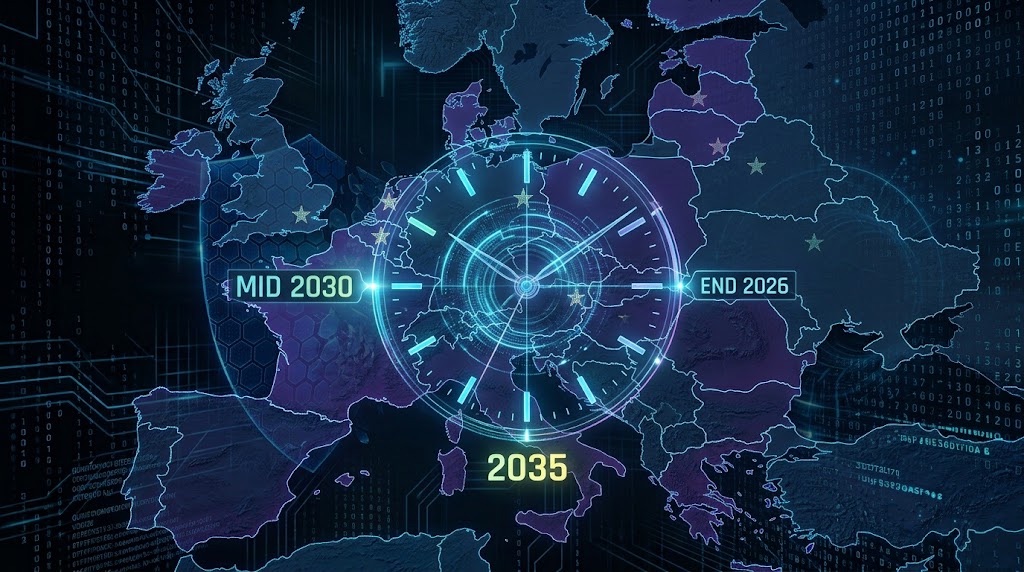
Quantum computers will eventually break the public-key cryptography most digital infrastructure relies on. Europe has already set the migration timetable: start by end of 2026, high-risk systems by 2030, everything else by 2035. The first step is knowing where your cryptography and your keys actually are.
There is a countdown running inside every organisation that handles sensitive data.
It is the arrival of a sufficiently powerful quantum computer. When that happens, widely used public-key cryptography will become vulnerable to quantum attacks, putting digital signatures, authentication and key-establishment mechanisms across digital infrastructure at risk.
Nobody knows exactly when that will happen. But replacing cryptography across large, interconnected systems can take years.
That is why the migration has already started.
Why Today’s Encryption Is Vulnerable
Systems such as RSA and elliptic-curve cryptography – widely used for digital signatures, authentication and key establishment – rely on mathematical problems that are extremely difficult for classical computers to solve. Quantum computers could change that.
In 1994, Peter Shor demonstrated that a sufficiently powerful quantum computer could solve the mathematical problems underlying RSA and elliptic-curve cryptography far more efficiently.
The machines capable of doing this do not yet exist at the necessary scale. But security agencies and researchers warn that adversaries may already be collecting encrypted data today with the intention of decrypting it later.
This strategy has a name: harvest now, decrypt later. It means that data you are encrypting today – medical records, financial transactions, identity credentials, classified communications – may already be compromised in the near future.
For information that needs to remain confidential or trustworthy for many years, that makes today’s decisions critical for tomorrow’s security.
What Post-Quantum Cryptography Actually Is
Post-quantum cryptography (PQC) is the field developing cryptographic algorithms that are secure against both classical and quantum computers. These are not algorithms requiring quantum hardware. They run on normal computers, chips, and infrastructure. The difference is in the mathematics they use – problems that are designed to withstand known quantum attacks.
The leading approaches include lattice-based cryptography, hash-based signatures, and code-based cryptography – each relying on different mathematical structures that resist quantum attacks. After an eight-year standardization process, the US National Institute of Standards and Technology published its first three finalized PQC standards in 2024, giving organisations a concrete foundation for migration.
Europe Is Already Setting the Timetable
Europe’s response is becoming increasingly concrete.
Recommendation (EU) 2024/1101, published in April 2024, called for a coordinated European transition to post-quantum cryptography.
In June 2025, the NIS Cooperation Group published a roadmap setting out a European migration timeline: Member States should start their transition by the end of 2026; high-risk use cases should transition by the end of 2030; and the remaining transition should be completed by the end of 2035, as far as practically feasible.
Then, in January 2026, the Commission proposed bringing PQC migration into the NIS2 framework through COM(2026) 13. It is still a legislative proposal, but it signals a shift from guidance towards formal cybersecurity policy.
Finance already has a binding requirement. Under DORA’s regulatory technical standards, Article 6(4) requires financial entities to include provisions for updating or changing cryptographic technology as cryptanalysis develops.
What About the European Digital Identity Wallet?
The European Digital Identity Wallet is a good example of why PQC matters.
It would be inaccurate to say that eIDAS 2.0 or the EUDI Wallet was designed specifically with quantum resilience in mind. The Wallet’s cybersecurity certification framework is being developed by ENISA, but that work should not be confused with a dedicated post-quantum migration programme.
At the same time, the Wallet is intended to become a long-lived identity infrastructure: users will store and share identity data and documents and create electronic signatures through it. Its security therefore needs to evolve as cryptographic standards evolve.
PQC is entering the wider European cybersecurity-certification framework through ENISA’s EUCC Guidelines on Cryptography and the ECCG Agreed Cryptographic Mechanisms (ACM) v2. The 2025 version significantly updated the guidance with recommendations on post-quantum cryptographic mechanisms.
The broader lesson is important: identity and signing infrastructure needs crypto-agility — the ability to replace or update cryptographic mechanisms without having to rebuild the entire system.
Why This Matters Especially in the Netherlands
The Netherlands has a particular reason to take this seriously.
It is one of Europe’s leading countries in quantum technology. In 2021, the Dutch government awarded €615 million from the National Growth Fund to the Quantum Delta NL programme, which runs until 2028.
At the same time, Dutch organisations are being asked to prepare for the security implications of quantum technology.
But the Netherlands has a readiness gap.
In February 2026, the Algemene Rekenkamer (the Netherlands’ Independent Court of Audit) reported that 71% of central-government organisations had not yet started preparations specifically aimed at protecting themselves against the quantum threat.
The figures highlight a striking contrast: the Netherlands is investing heavily in developing quantum technology, while much of its central government has not yet begun preparing for the cryptographic threat quantum computers pose.
For Dutch companies, the European deadlines therefore are not an abstract Brussels issue. They sit alongside a very practical question: do we actually know where our cryptography is, and how difficult would it be to change?
What Organisations Should Do Now
The first step is not necessarily deploying PQC.
It is finding the cryptography they already have.
Cryptography is embedded in authentication, digital signatures, APIs, identity verification, certificates and third-party systems. Organisations need an inventory of which algorithms are being used, where they are used, what they protect, which dependencies they control and, increasingly, which tools have access to them.
Then comes prioritisation: which systems handle information that needs to remain secure for years, and which systems are most difficult to replace?
Finally, organisations need to understand whether their architecture is crypto-agile.
Where Are Your Keys Right Now?
The familiar examples of poor cryptographic hygiene are legacy ones. An algorithm nobody dared touch. A certificate handled by a supplier and forgotten. A key written into a system built before anyone thought about rotation. These are real well-understood problems and software built to modern standards largely avoids them.
The newer problem is different. Development itself has changed. Code is written alongside AI assistants. Agents are given access to repositories, pipelines and environments. Each of these is an ordinary, productive act. Each of them is also a place where a key can leave the building without anyone deciding that it should.
Harvest now, decrypt later assumes an adversary has to capture your encrypted data and then wait years for the mathematics to catch up. A leaked key requires neither.
So the cryptographic inventory that European policy is asking for is not only a question about algorithms and expiry dates. It is a question about access. Which systems, which suppliers, and now which tools can reach your keys, and would you know if one of them had?
An organisation that cannot answer that today will not be able to answer it in 2030 either, whatever algorithms it has deployed by then.
At Sourcelab we are not cryptographers, and we would be wary of any software company that claimed to be. The post-quantum algorithms themselves will come from the standards bodies and the specialists who design them.
What we build is the layer where their work lands: identity, signing, onboarding and the systems around them, for clients across Europe. Whether an organisation is actually able to adopt a new cryptographic standard when it arrives is not a mathematics question. It is an architecture and engineering question, and that is the part we pay attention to.