Digital Trust Is More Than Security
Digital trust is the confidence a user has that a platform will protect their data, behave as promised, work when needed, and hold up under regulatory scrutiny.
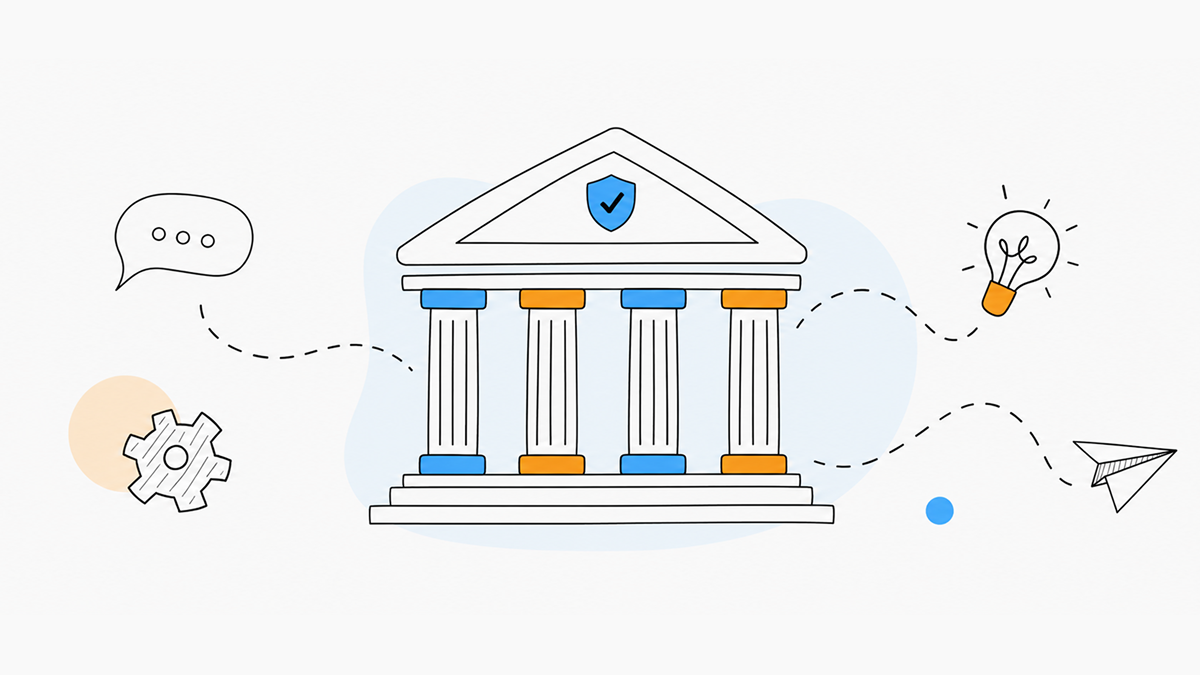
Digital Trust is More than Security: The Pillars Every Product Team Needs to Know
Ask a founder to define “digital trust” and nine times out of ten you will get one word back: security. Guaranteed by firewalls, encryption, penetration tests, and a SOC 2 badge in the footer of the website. This is not wrong, but is just a quarter of the answer.
Digital trust is the confidence a user has that a platform will protect their data, behave the way it claims to, work when they need it to, and hold up under regulatory scrutiny. Security is only one input into that confidence. So is the five seconds it takes someone to figure out where their onboarding data goes. So is whether your app was still down the time when their transaction needed to clear. Product teams that only defend the security dimension are leaving three-quarters of the trust equation unmanaged. And our experience tells, users notice that.
This is the piece we keep reinforcing in all Sourcelab strategic projects, because the pillars below are the operating framework we use with every product team working with us.

A Quite Expensive Misconception: Digital Trust Is Equal to Cybersecurity
The instinct to equate trust with security is understandable. Security is the pillar with the scariest failure mode. But the data tells a more complete story.
Usercentrics’ 2026 State of Digital Trust report, based on a survey of 11,000 consumers across seven European and US markets, found that trust in AI handling personal data dropped sharply year over year - actually, the steepest single-year decline the study has ever tracked.
When asked what would rebuild that trust, respondents pointed to 3 separate things in roughly equal measure:
- clearer explanations of how data gets used;
- stronger security guarantees;
- more control over what they share.
….and you will notice that only one of those 3 is a security answer.
What is also worth noticing is that nearly half of consumers say they have taken an action with real revenue consequences in the past 6 months over AI-related data concerns: cancelling a subscription, switching providers, or cutting spend. In the UK specifically, 80% of consumers say they would abandon a service outright over data misuse.
Security failures matter, too. The share of consumers who say they lose trust in a brand immediately after a breach is roughly two-thirds, with about a third saying they would permanently stop doing business with a company after a financial data exposure.
But a security-only response misses everything else that determines whether users trusted you enough to stick around before anything went wrong: the experience, the transparency, the compliance posture.
And this is the gap the digital trust framework closes.
The Pillars of Digital Trust
Digital trust breaks down into the following main pillars: Experience, Transparency, Infrastructure, and Compliance. Each answers a different question a user is unconsciously asking about your platform, and weakness in any one pillar undermines the others. A beautifully designed app that leaks data isn’t trustworthy. And a compliant platform that’s impossible to use will not get adopted, no matter how many certifications it holds.

Experience: Smooth UX/UI
Does your application feel like something built for a user, or something they have to fight with?
User-centric design is not a nice-to-have layer on top of trust. Confusing flows, unexplained steps, and dead-end error states all are signals for incompetence, and users generalize incompetence in one area to risk in every other area. If someone can’t tell whether their signup form is saved correctly, it’s a short mental leap to wondering whether it was saved securely.
For regulated-industry platforms specifically, friction has a compounding cost: onboarding in banking, healthcare, or identity-verification contexts often requires extra steps (KYC checks, document uploads, biometric verification). The teams that win here don’t remove those steps, but make the necessity of each one legible, so the friction reads as diligence rather than incompetence.
Transparency In Communication
Do users know who is actually behind the system, and where their data is going?
Transparency means clarity on who operates the platform and full visibility into where data resides. And here we mean not a privacy policy nobody reads, but active, in-context communication about what’s collected, why, and what happens if a user says “no”.
Over half of consumers globally now say they will pay more for brands that are transparent about how they use data with AI, and in Germany that figure climbs past 70%, the highest of any market Usercentrics studied. Transparency isn’t just risk mitigation anymore, but rather a monetizable feature that you simply cannot ignore.
Infrastructure: Reliability & Security
Will the application work when anyone needs it, and is their data actually safe?
This is where stable performance meets robust cybersecurity. In a user’s mind they are often inseparable: an app that is frequently down feels just as untrustworthy as one that has been breached, even though the underlying causes are entirely different.
Reliability covers uptime, latency under load, and graceful degradation - does the platform fail loudly and safely, or silently and badly? Thales’ research found that well over half of consumers experienced website access issues in the past year, and each of those incidents chips away at confidence the same way a security lapse would, just with less press coverage.
Security is the layer most product teams already invest in, and rightly so. The upside case is strong: organizations using AI and automation extensively for security have reported multi-million-dollar savings per breach and meaningfully shorter breach lifecycles. Security posture also functions as a trust signal and not just a defense. A majority of consumers say multi-factor authentication would increase their trust in a company, even though MFA adds friction. This is clear proof that users will accept friction from Infrastructure but they won’t tolerate from experience, as long as the reason is obvious.
Compliance: Standards-Driven Trust
Is your platform actually held accountable, or just claiming to be?
Compliance means strict adherence to regulations like GDPR, NIS2, and DORA. For most of the market players this pillar started being a hard deadline for certification or validation to pass.
Three dates matter right now:
- eIDAS 2.0 / EUDI Wallet: every EU member state must make at least one EU Digital Identity Wallet available by late December 2026, with private-sector platforms in regulated sectors (banking, healthcare, telecoms, large online platforms) required to accept it as an authentication method roughly a year later, by late 2027. If your product touches identity verification, QES, or OID4VP flows, this isn’t a future consideration but a priority for this year.
- NIS2: the first compliance audit deadline for in-scope entities lands mid-2026, with national transposition deadlines converging around October 2026. Non-compliant essential entities face fines up to €10 million or 2% of global turnover, whichever is higher.
- DORA: already applicable to financial entities since January 2025, DORA is now entering its first genuine supervisory enforcement cycle, with regulators including Germany’s BaFin and the Netherlands’ AFM and DNB actively running supervisory reviews.
Sourcelab’s advice: If you are just about to address the topic in your organization, mind that you are not asking the CTO to plan it in the next year’s budget. Instead, you are helping them close a personal liability gap that already has a date attached to it.
Why The Framework Compounds

The pillars above are not independent checkboxes and they multiply over time. A platform with excellent Infrastructure but unclear Transparency still loses users, because lack of visibility into data handling remains one of consumers’ top-cited concerns regardless of how well the systems underneath actually perform. Equally, a beautifully transparent, frictionless product that isn’t Compliance-ready in a regulated market simply can’t be sold into it. The deal dies in procurement, not in the UI.
This is also why the focus on security is an increasingly weak pitch on its own. Companies with mature digital trust practices are meaningfully more likely to post double-digit revenue growth, and that reflects all the pillars working together, not security in isolation.
Where Sourcelab Comes In

We build SaaS platforms for product managers and CTOs across the Netherlands, DACH, UK, and Nordics for whom digital trust is mission-critical. The pillars above are the framework everything we ship gets measured against.
Most vendors in this space still operate as order-takers: tell them what to build, and they’ll build it. We start differently. Our approach is Seek to Understand: mapping your actual trust gaps against these pillars before a single line of code gets written, because a platform that’s secure but unusable, or compliant but untransparent, hasn’t solved the problem. It has just relocated it.
Contact our team to learn more and discover how we can help your business serve as a role-model when it comes to digital trust.